OpenLens focuses on community health, contribution quality, and actionable signals so maintainers can spend less time filtering spam or duplicates, and more time merging meaningful work.
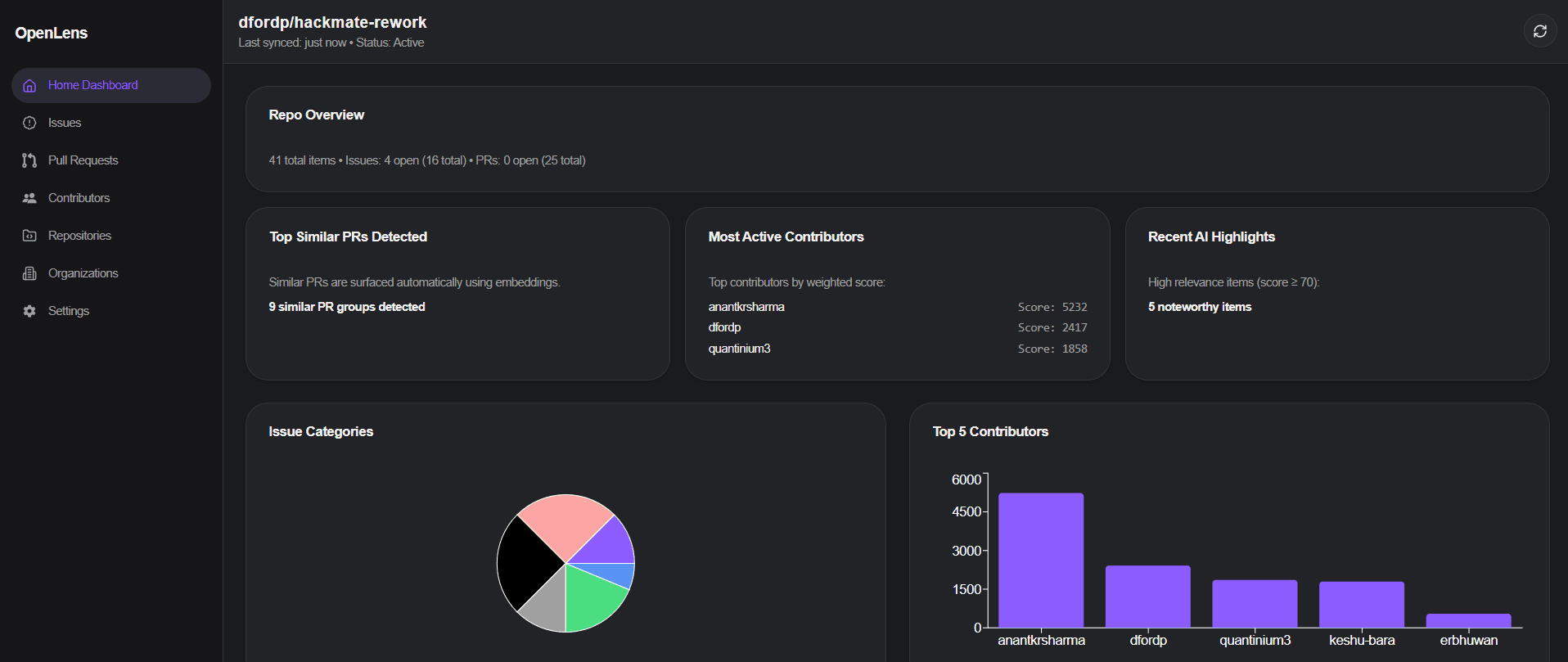
Overview
Sentinel is a GitHub App built to help open-source maintainers reduce noise and surface meaningful contributions. Instead of focusing solely on code review, Sentinel highlights contributor history, semantic similarity across past work, and low-effort PR indicators. The system is designed to make triage faster for repos that receive high volumes of community activity.
This MVP demonstrates a minimal but functional workflow: loading a repository, embedding all open PRs and issues, identifying related work, and presenting actionable context through a streamlined dashboard.
What It Does (MVP)
- Sync any GitHub repository’s open PRs and issues into a workspace.
- Generate vector embeddings for each item using pgvector.
- Detect related or duplicate PRs and issues through semantic search.
- Surface contributor insights (first-time contributor vs returning).
- Flag weak or low-effort contributions based on metadata signals.
- Allow repositories to be loaded or discarded without persistence overhead.
Why It Matters
Maintainers of active open-source projects face a constant volume of noise: duplicate PRs, malformed issues, abandoned attempts, and low-effort contributions. Reviewing them manually erodes time that could be spent improving the project.
- Spam and duplicate PRs often disguise themselves as genuine contributions.
- Context switching across many historical issues slows down triage.
- Maintainers rarely have enough time to understand contributor patterns.
Sentinel uses embedding-based retrieval, contributor profiling, and simple heuristics to reduce triage time and help maintainers focus on meaningful work.
Technical Overview (MVP)
- Backend: FastAPI for webhooks, sync jobs, and insight APIs.
- Frontend: Next.js + Tailwind for the maintainer dashboard.
- Database: PostgreSQL with pgvector for embeddings and semantic lookup.
- Workers: Background tasks for syncing, vectorizing, and cleaning repo data.
- Auth: GitHub App installation flow with repo-scoped permissions.
Data Flow
- Maintainer installs the GitHub App and selects a repository.
- A webhook triggers the backend to enqueue a repo-load job.
- Workers fetch PRs and issues, generate embeddings, and store them in Postgres.
- Frontend retrieves insights: similar PRs, related issues, contributor history.
- A cleanup routine removes data when the repo workspace is closed.
Features in MVP
- End-to-end GitHub App integration
- Repo loader with background sync
- pgvector-based embedding and search
- Similar PR/Issue retrieval
- Contributor metadata and history
- Dashboard for insight consumption
- Cleanup endpoints for temporary workspaces
System Architecture
            Backend: FastAPI
            - Webhook receiver
            - Sync jobs and embedding pipeline
            - REST API for insights

            Database: PostgreSQL + pgvector
            - pr_embeddings
            - issue_embeddings
            - contributor history

            Workers:
            - Sync worker
            - Embedding worker
            - Cleanup worker

            Frontend: Next.js Dashboard
            - PR view
            - similarity panels
            - contributor context
Future Roadmap
- AI-powered classification of PRs (spam, duplicate, valuable).
- Contributor trust and reputation scoring.
- Organization-wide community health dashboards.
- Long-term semantic history tracking and knowledge graph generation.
- Deeper GitHub App permissions and automated triage suggestions.
Deployment
- Local: Docker Compose (backend, frontend, Postgres).
- Cloud: Supabase for Postgres, Vercel for frontend.
- Workers deployed via Railway or Fly.io.
- Automatic cleanup of temporary repo data after sessions.
Target Users
- Open-source maintainers
- Community managers
- Developer relations teams
- Engineering orgs with external contributors